
Faced with a growing drone threat, businesses, organizations, and security forces must now morethan ever monitor their activities, sites, and infrastructure, as well as protect their operations inthe field. They need solutions able to detect, identify, track, and neutralize hostile drones, whetherin fixed, mobile, or deployable environments.
CS GROUP designs, deploys, and maintains C-UAS systems, drawing on its businessexpertise, its range of command and control (C2) centers, and its ability to integrate sensorsand effectors.

BOREADES is the C-UAS solution designed and deployed by CS GROUP since 2015. It is aflexible and scalable solution that addresses the challenges of protecting different types of sensitive sites by detecting, identifying, assessing the threat, and neutralizing drones.
With more than 50 operational systems deployed in France and internationally, the solution is based on major references: the MILAD, ARLAD, and PARADE programs for the French armed forces, RADIANT for the Paris Police Prefecture, as well as participation in the European JEY-CUAS and E-CUAS projects. BOREADES also contributed to the successful securing of the airspace at 18 sites during the 2024 Olympic and Paralympic Games in Paris.

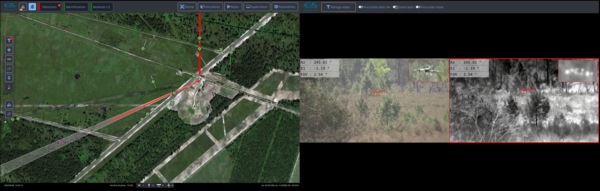
CS GROUP is making a C2/effector interoperability standard publicly available to companies wishing to offer a neutralization system based on an airborne effector. This standard covers all protocol aspects enabling the implementation of a link between C2 and effectors.
To facilitate the integration of this standard, CS GROUP also provides, upon request, a simulator that emulates the behavior of a C2.
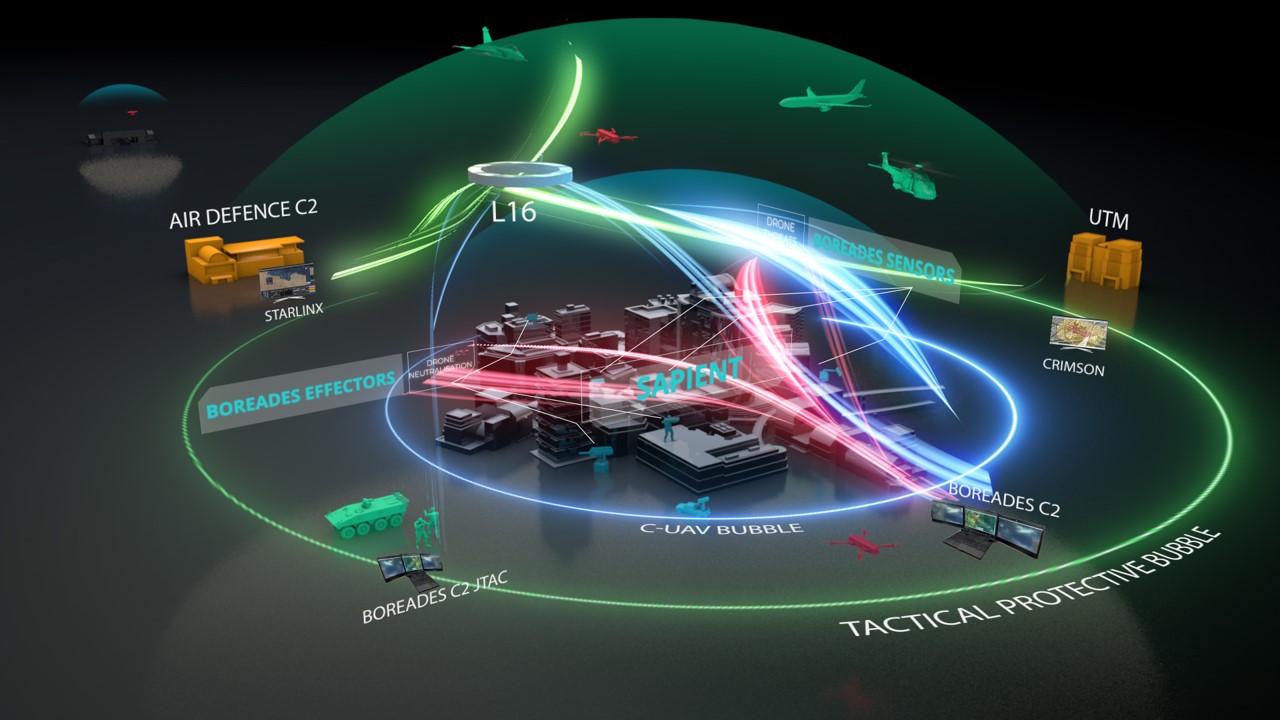
CS GROUP is committed to interoperability through its ongoing participation in NATO TIE exercises since 2021.
The JEY-CUAS project (EDIDP, 2021–2023) was launched at the end of 2021 by the European Commission with the aim of defining a European anti-drone system for defense purposes.
This project brought together more than 40 C-UAS manufacturers in Europe, coordinated by Leonardo. The work focused mainly on system architecture, with a view to interoperability, and the development of technological building blocks: C2, sensors, and effectors.

The E-CUAS project, selected by the European Commission as part of the European Defense Fund, aims to define, develop, test, and evaluate the future European C-UAS system.
With €43million in funding from the European Commission and a total budget estimated at €71 million, E-CUAS is a continuation of the JEY-CUAS project, with a smaller consortium of participants. Within this project, CS GROUP is positioned on a Franco-Belgian mobile scenario and our role in this project will be to provide the C2 system embedded in a vehicle.

ALADDIN is a European project coordinated by CS GROUP and funded by the European Community in the Horizon 2020 program framework. The ALADDIN consortium comprises 18 European partners, including industrials, academic bodies and End Users (LEA – Law Enforcement Agencies).
The aim of the project is to develop a seamless and tighly integrated counter-UAV system. This is achieved through study and assessment of existing relevant technologies and regulations, in order to design, implement, integrate and demonstrate a scalable platform extending state-of-the-art capacity for the detection, localisation, and neutralization of drones with unprecedented accuracy and effectiveness. Aladdin offers innovative functionnalities enabling the training of operators, the storage of information for simulation and after action review, the support to investigation (e.g. localization and identification of the drone pilot), and a modern 3D mixed reality interface for improved effectiveness and user-friendliness.
RAPTOR is a research project run by CS GROUP in Canada on behalf of CSC (Correctional Service of Canada) whose aim is to develop and demonstrate a cost-effective counter-UAV solution. Funded by DRDC (Defence Research and Development Canada), the solution is designed to detect, identify, track and neutralize rogue drones.
RAPTOR is a counter-UAV solution allowing users to rapidly identify threats and to take the appropriate decision. It will be available in a range of configurations to meet various operational needs: detection of contraband deliveries by drone; detection and neutralization of drones flying over restricted areas, and on-the roas mobile installation system designed for event protection.
The two-year RAPTOR project output will consist in three system demonstrations organized at Drummond Institution in Quebec.