
The Francophone Meetings on Fuzzy Logic and its Applications (LFA) once again brought together academic and industrial researchers in Clermont-Ferrand on November 6-7, 2025. This flagship event of the Francophone community provided a platform to share the latest advances in uncertainty theories, far beyond the original scope of fuzzy logic.

A celebrated scientific legacy
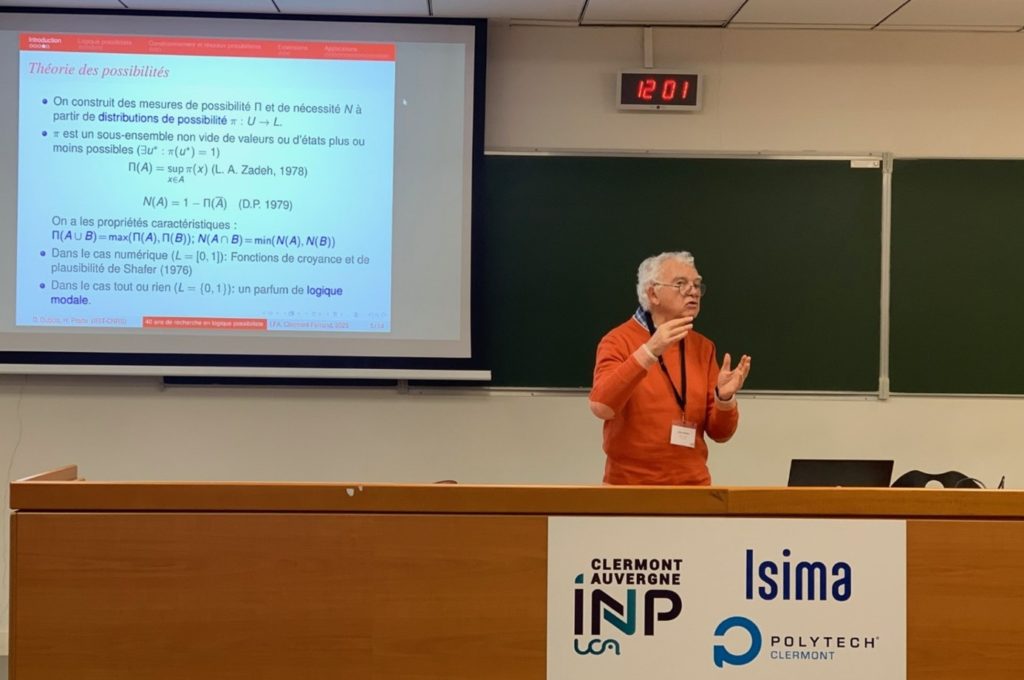
This edition marked a double anniversary: the 60th anniversary of Lotfi Zadeh’s foundational paper “Fuzzy Sets”, which revolutionized the modeling of imprecision, and the 40 years of research on possibility theory led by Didier Dubois and Henri Prade, two major figures in fuzzy logic, possibility theory, and uncertain reasoning. Both were CNRS research directors at the Institut de Recherche en Informatique de Toulouse (IRIT), affiliated with the University of Toulouse III – Paul Sabatier, and are now emeritus research directors at the CNRS. Their contributions were honored in a special session, highlighting the international impact of their work on artificial intelligence, information fusion, and decision-making.
A rich and diverse program
Twenty-four papers were presented through short talks followed by in-depth discussions in front of their corresponding posters. The exchanges covered a wide range of topics, from machine learning to fuzzy reasoning, including explainability, preference management, data mining, and information fusion, through fuzzy logic, possibility theory or belief functions.
Invited talks: Practical solutions for managing inconsistencies
Anne-Laure Jousselme (CS Research Lab) presented recent advances on inconsistency measures in belief function theory, which are essential for evaluating, comparing, and optimizing systems in uncertain and multi-source contexts (e.g., maritime surveillance, threat analysis, etc.). Salem Benferhat (CRIL, University of Artois) presented methods for detecting and correcting inconsistencies in databases, particularly for geographic information systems or wastewater networks, based on logics adapted to lightweight ontologies.
The LFA conference remains a unique venue for debate, idea exchange, and constructive feedback, strengthening the links between theory and industrial applications. The 2025 edition once again underscored how uncertainty theories, far from being abstract, address concrete challenges posed by the increasing complexity of data and decision-making environments.
A big thank you to Violaine Antoine (LIMOS, ISIMA, INP Clermont Auvergne) for her local organization, Jean-Philippe Poli (CEA LIST, Université Paris-Saclay) for scientific coordination, and all members of the LFA steering committee for the quality and richness of this event. Their dedication ensures that the LFA continues to be a pivotal gathering for the future of uncertainty sciences.